
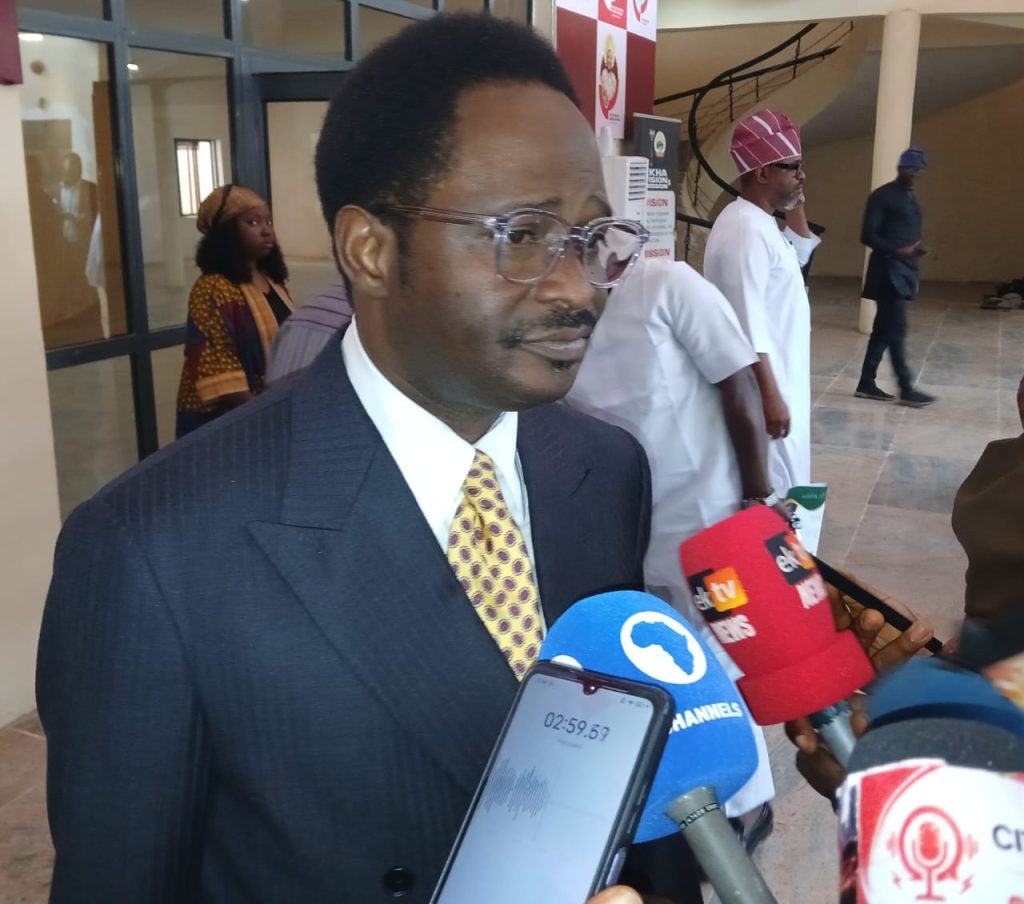
A legal luminary and private-sector investor, Mr. Tope Adebayo, has said the thirty years creation anniversary of Ekiti State should be seen as a moment to look Backward with Gratitude and forward with ambition.
He made the remarks on Tuesday, while delivering the keynote address at the public hearing organised by the Ekiti State House of Assembly to mark the 30th anniversary of the creation of the state, saying, the State should transit from being known as the “Land of Honour” to a “Land of Opportunity,” where talent is matched with enterprise and education is converted into economic capital.
The event, which was held at the Hallowed Chamber of the State Assembly in Ado-Ekiti with the theme “Ekiti at 30: Reflecting on Our Journey, Charting Our Future,” had in attendance, the Speaker of the House, the Rt. Hon. Adeoye Aribasoye, lawmakers, traditional rulers, former public office holders and other stakeholders.
Adebayo noted that the development of Ekiti has been a continuum built by successive administrations, each contributing to the foundation of the state.
The legal practitioner said the creation of Ekiti in 1996 was the fulfilment of the aspirations of a people who believed in common identity, culture and intellectual heritage and deserved to bring governance down to the grassroot.
The keynote speaker commended the Oyebanji administration for its six-pillar development agenda covering governance, youth development and job creation, human capital development, agriculture and rural development, infrastructure and industrialisation, as well as arts, culture and tourism.
According to him, the administration’s philosophy of consolidating progress and scaling impact is crucial, as significant development is rarely achieved in a single political cycle.
He cited achievements of the present government to include over 6,000 hectares of land cleared for agriculture, support for thousands of farmers, road and rural infrastructure projects, investments in the Ekiti Knowledge Zone, MSME financing, and vocational training.
On the executive-legislature relationship, Adebayo lauded the synergy between Governor Oyebanji and the Assembly under Speaker Aribasoye, noting that the remodelling and digitalisation of the legislative complex was an investment in the dignity and effectiveness of the legislature.
Sharing his personal story, Adebayo, who was born in Igbara-Odo and schooled in Igbara-Odo, Ikere and Ado-Ekiti before becoming a lawyer and an entrepreneur, said his experience had shaped his belief that leadership must combine empathy with competence and execution.
He disclosed that after contesting the governorship election in 2018 with human capital development as his central theme, he personally sponsored the enrolment of youths at the Technical School in Igbara-Odo, leading to over 1,000 per cent increase in enrolment, with stipends for about 60 students.
“Skill acquisition is one of the most powerful pathways out of poverty. A young person who learns a trade should not be regarded as somebody who failed to go to university. That young person can become an employer of labour,” he said.
Adebayo proposed a five-point agenda for the next phase of Ekiti’s development.
He said human capital must become economic capital by linking training directly to industry; agriculture must move from production to processing, packaging and export; Ekiti must be made a private-sector destination through predictable regulation, faster approvals and reliable infrastructure; infrastructure must serve production; and the state’s intellectual advantage must be converted into innovation and enterprise.
“Let us produce. Let us process. Let us package. Let us market. Let us export,” he charged.
He stressed that the objective should be to build institutions that survive individuals, noting that governments will change but Ekiti as an institutions must become stronger to create a trans-generational state.
In his conclusion, Adebayo said the ultimate test of development is not how successful a few become, but how many more people are given the opportunity to succeed. He said envisioning an Ekiti where youths do not have to leave the state to find good jobs elsewhere, where farmers are linked to factories and technology companies operate from Ado-Ekiti, Ikere, Ikole and Ijero is achievable through collective reasoning and participation.