
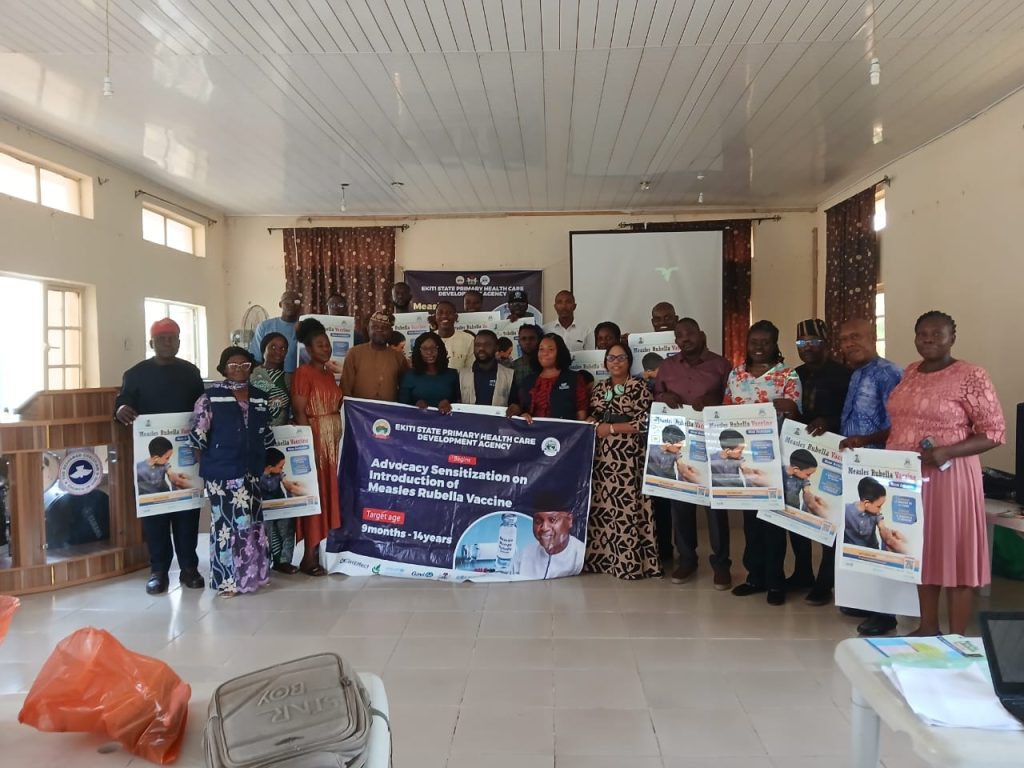
The Ekiti State Primary Health Care Development Agency (EKSPHCDA) has called on journalists and other relevant stakeholders in the media sector in Ekiti State to join hands with the agency in ensuring a successful implementation of Measles – Rubella vaccination to the children in the state as part of efforts to protect the children and close existing immunity gaps across the state during the vaccination exercise coming up in January.
This was made known in a one day media chat with journalists in Ekiti State organised by the agency in partnership with UNICEF, WHO and other stakeholders recently in preparation for the commencement of the vaccination exercise for children between the age of 9 months to 14 years billed for January, 2026.
Speaking at the event, the outgoing State Health Educator, Dr. Mrs Olajumoke Oguntoye said the main objectives of the meeting is to orient the media practitioners about the introduction of Measles – Rubella vaccine in Ekiti State.
She noted further that, it is also important to provide accurate information on the safety, effectiveness and importance of the MR vaccine, to clarify campaign strategies, implementation timeline, and target population.
Olajumoke said further that other reasons for the meeting include, strengthening collaboration between the media and the health sector for effective demand generation, addressing the issues of misinformation, myth, and public concern regarding the MR vaccine and to solicit media support for wide dissemination of key campaign messages before and during the campaign.
Dr Olajumoke highlighted further that media practitioners are very key to the success of the Measles – Rubella campaign in the state because no health programme can see the light of the day without the full involvement of the media since they communicate with the community directly.
Speaking at the event, the Director of Disease Control and Immunization, Dr. Segun Adeoye, described immunization as one of the most effective public health interventions globally, stressing its critical role in reducing morbidity and mortality among children and mothers.
According to him, reaching every household directly is practically impossible. He emphasized that media remains an indispensable partner in public health campaign saying media credibility enhances community confidence.
Dr. Adeoye explained that the media orientation was organized to properly equip journalists with accurate information on the MR vaccine, its safety, effectiveness, target population, and campaign strategies, in order to ensure consistent and responsible public messaging. Adding that collaboration between the health sector and the media is essential in combating misinformation, myths, and public concerns surrounding vaccination.
The State Immunization Officer, Mrs. Ogunlola Omolabake, disclosed that the MR vaccine would be introduced into routine immunization in the third week of January, preceded by a 10-day statewide vaccination campaign. She explained that the campaign would target children aged 9 months to 14 years, after which the vaccine would become part of routine immunization for children at 9 months and 15 months as first and second doses respectively, replacing the existing stand alone measles vaccine.
Mrs Ogundola stated that the campaign targets 17% of Ekiti State’s total population, noting that achieving between 90% and 95% of this target would be considered a successful implementation. She added that both administrative coverage data and post-campaign surveys would be used to assess the effectiveness of the exercise.
On implementation strategies, she revealed that all 317 health facilities offering routine immunization across the state would remain open throughout the campaign period. In addition, mobile teams would be deployed to communities to set up temporary vaccination posts, while targeted outreach would be carried out in rural areas, factory settlements, Fulani camps, and security-compromised locations, in collaboration with security agencies where necessary.
The World Health Organization (WHO), representative in Ekiti State, Dr. Ebube Eronini, described the campaign as a critical intervention aimed at closing immunity gaps against highly contagious measles and rubella infections. She noted that the exercise would cover all communities and settlements in Ekiti State to ensure that no eligible child is left behind.
Dr. Eronini explained that measles, a highly contagious viral disease, can lead to severe complications such as malnutrition, blindness, encephalitis, and death, particularly among children under age five. She added that rubella poses serious risks to pregnant women, often resulting in congenital rubella syndrome, which can cause hearing loss, heart defects, and visual impairment in infants.
Calling for widespread participation, the State Technical Assistant for the International Vaccine Access Centre (IVAC), Mrs. Aladenika Folakemi, urged parents and caregivers to take advantage of the campaign window, noting that children above the eligible age would no longer have access to the vaccine once it is fully integrated into routine immunization.
On community engagement, the State Health Educator, Dr. Mrs. Olajumoke Oguntoye, remarked that extensive advocacy and sensitization activities had already been carried out across all 16 local government areas of the state. Stating that traditional rulers, religious leaders, school authorities, parent-teacher association, and education stakeholders have been engaged and have endorsed the vaccination exercise.
Health officials at the meeting collectively appealed to parents, caregivers, community leaders, religious institutions, schools, and the media to support the campaign, stressing that its success depends on collective responsibility and community acceptance.
They reaffirmed that the 10-day Measles–Rubella vaccination campaign will commence in the third week of January 2026, urging families to fully participate in order to safeguard public health and secure a healthier future for children in Ekiti State.
Important dignitaries present at the meeting include, State immunisation officer, Mrs Ogundola Omolabake, UNICEF representative, Mr Raiwan Olasunkanmi, State Technical Officer from IVAC, Mrs Aladenika Folakemi, WHO representative in Ekiti State, Dr Ebube Eronini, Dr Mrs Olajumoke Oguntoye, Director Disease Control and Immunisation, Dr Adeoye Segun, Mr Bamisaye and host of others